

Living Room Curtain Ideas: 10 Ways To Transform Your Space
Of all the things you can do to a living room, curtains might be the most underrated. The right living room curtains soften a space, add warmth and colour, control how much light gets in, and pull a room together in a way that furniture alone just can't. Long panels of fabric framing a window create a sense of height and intention that makes even a simple room feel finished and considered.
And yet, curtains are one of those things people put off way too long. You move in, you tell yourself you'll "sort the windows later," and then three years pass, and there's still a sad set of venetians from the previous owners doing absolutely nothing for the room.
Sound familiar? You're not alone.
The good news: getting the right curtains up is easier than most people think, especially when they're made to measure and designed for DIY installation. And the difference they make? Massive. We're talking colour, warmth, texture, light control, and privacy all in one simple change.
Here are 10 living room curtain ideas to get you thinking (and finally doing something about those windows).
A Few Things Worth Thinking About First
Before you fall in love with a fabric, it's worth nailing down a few basics:
What's the vibe of the room? Your curtains don't need to match everything, but they should feel like they belong. Think about your existing colours, textures, and overall style. Curtains that contrast too sharply tend to look like an afterthought, while ones that are too matchy can feel flat.
How will you use them day to day? Will you open and close them daily, or are they mainly decorative? This will guide your choice of header style and hardware. Pinch pleats on a rod look beautiful but take a little more effort to draw, while an S-fold on a track glides open in seconds. Could adding motorisation make them easier to manage?
How much light and privacy do you need? This one's big. The fabric you choose controls how much light filters through, and the lining you add (or don't) determines privacy and insulation. A sheer fabric gives you softness and daylight. A blockout curtain gives you total privacy and darkness. Most people end up wanting something in between, and that's where fabric weight, product combinations and dimout fabrics come in.
If you're not sure, our design consultants offer free sessions to help you work it out. No obligation, no showroom, just genuine advice.
1. Try Colour Drenching for a Bold, Cohesive Living Room
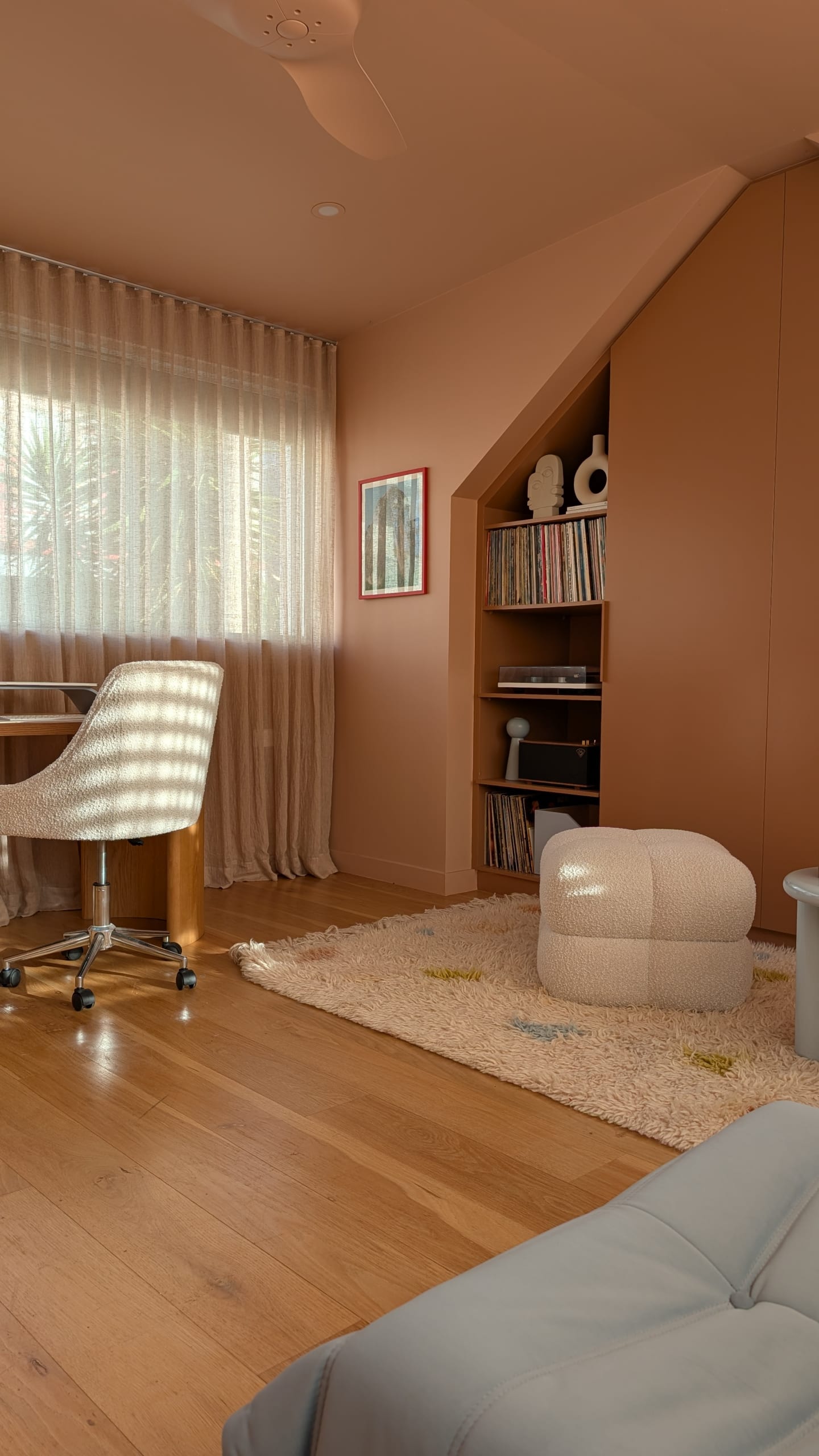
Colour drenching is one of the biggest interior trends right now, and it's also one of the easiest to understand: pick one colour and commit to it everywhere. Walls, ceiling, skirting boards, and yes, your curtains too. The result is an immersive, considered look that feels intentional rather than accidental.
The reason it works so well is that eliminating contrast between surfaces makes a room feel larger and more cohesive. There are no visual interruptions, no curtain that breaks away from the wall, no ceiling that draws the eye up and then stops. Everything reads as one continuous, enveloping space.
Curtains are the most important part of getting colour drenching right. If your walls are a dusky pink and your curtains are white, the effect falls apart. Made-to-measure curtains in a fabric that matches or closely complements your wall colour are what takes it from "bold room" to "properly designed space."
For header style, S-Fold curtains work beautifully with colour drenching because the soft, continuous waves add texture and movement to what could otherwise feel like a flat wall of colour. The fabric does the design work; the colour ties the whole room together.
2. Create Height with Floor-to-Ceiling Curtains
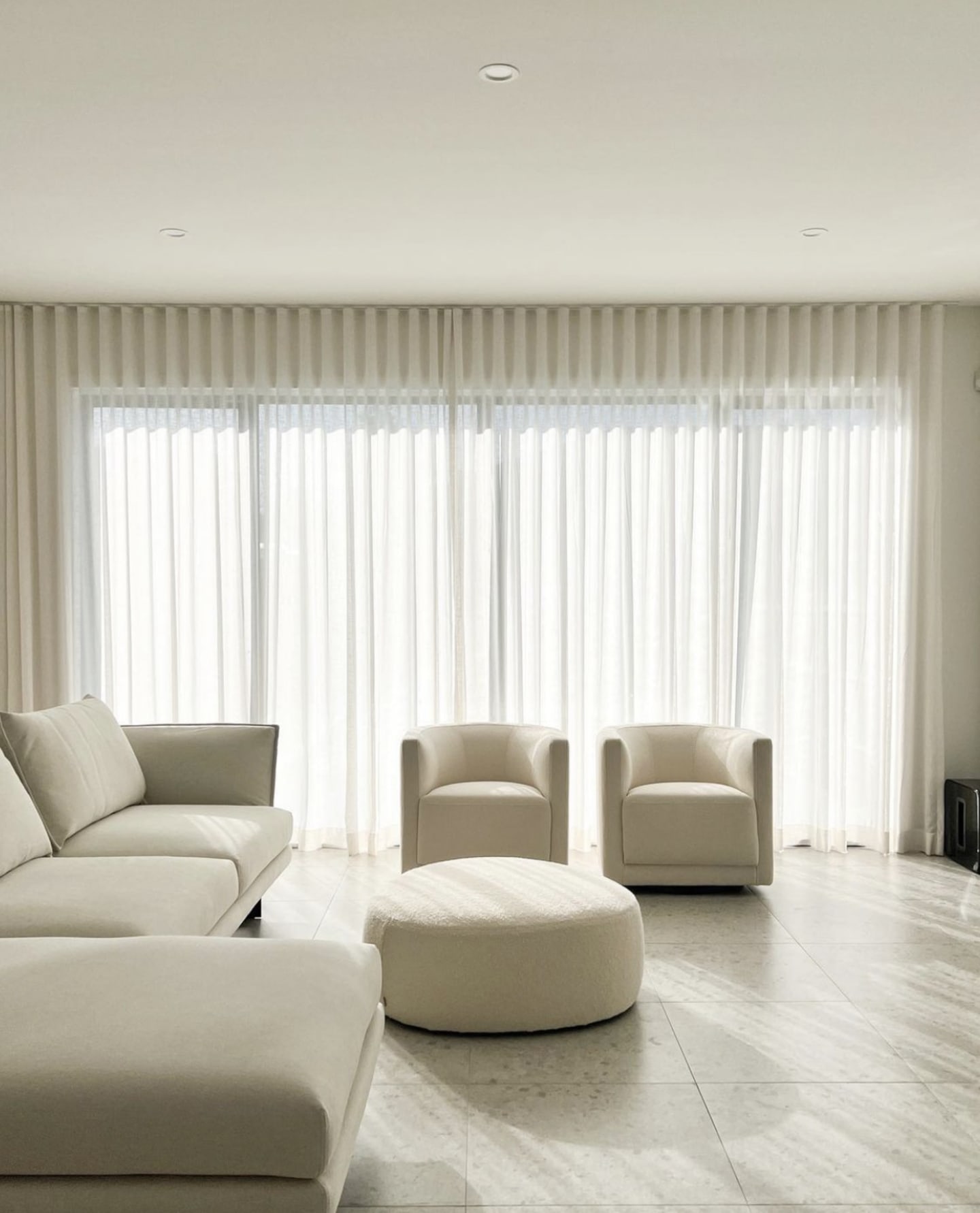
Floor-to-ceiling curtains are one of the easiest ways to make a living room feel more impressive, and the best part is you don't need big or tall windows to pull it off. The trick works on any window size: go for top fit/ceiling mount when customising your curtains. Curtains that hang from your ceiling have a designer look and maximum impact, and they look incredible combined with an S-fold.
The continuous wave of the S-fold curtain running from ceiling to floor creates a clean, uninterrupted line that feels both modern and considered. If you want a slightly more structured look, pinch pleat curtains are a great alternative: a triple pinch pleat adds definition at the header without looking fussy, and the fabric falls in neat, even folds below. Either way, a subtle texture or woven fabric adds depth without competing with the drama of the drop.
3. Earthy Tones: S-Fold Curtains for a Nature-Inspired Space
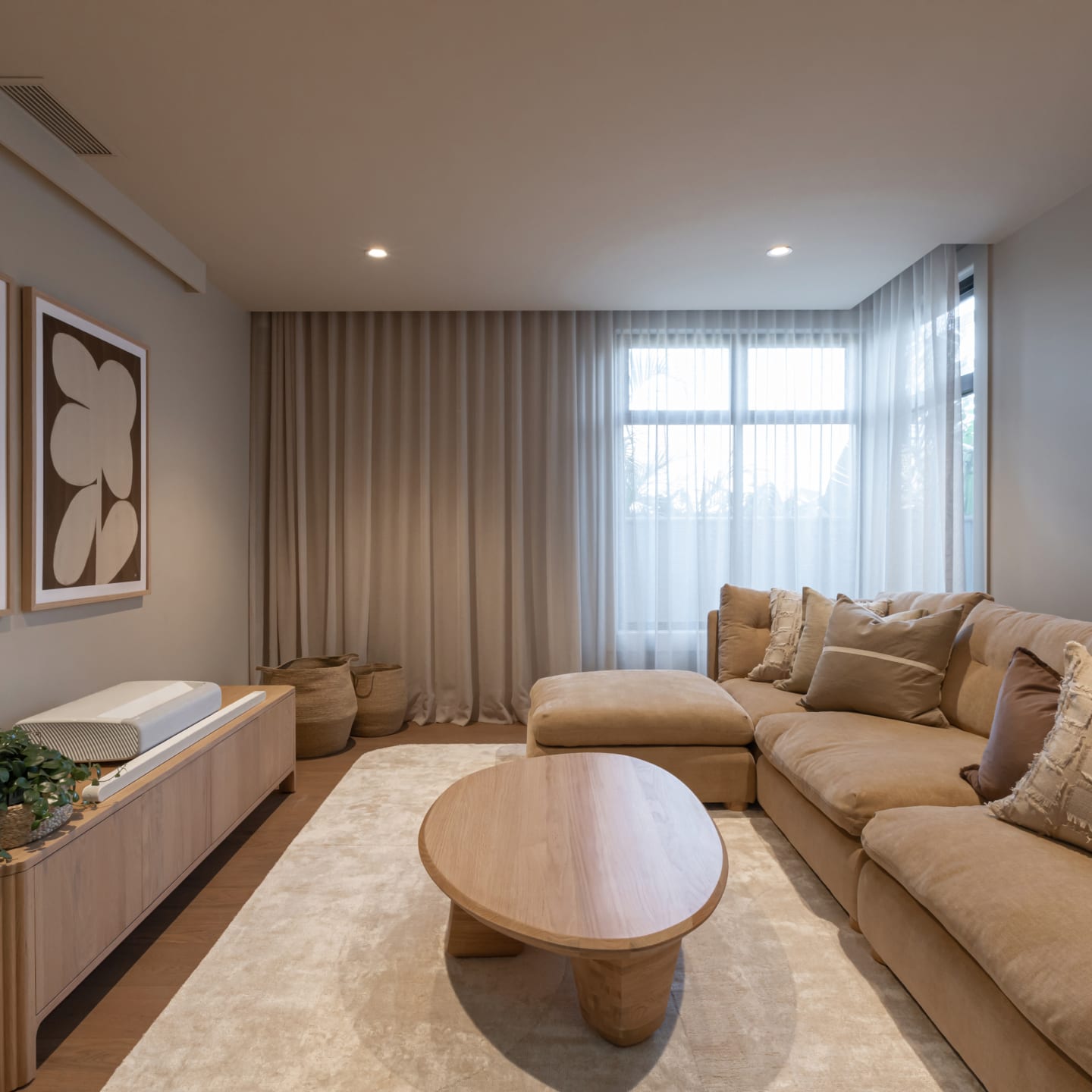
Timber floors, rattan furniture, indoor plants: if that's your living room, you're working with a warm, organic palette that earthy curtains will slot right into. Think warm moss green, rich ochre, deep brick, or truffle. Nothing too vivid, nothing too stark.
Colour is only part of the equation here. Texture is what makes an earthy scheme feel genuinely layered rather than just brown. A linen-blend fabric in one of these tones has a subtle woven surface that catches light differently throughout the day, adding depth without pattern. A dimout fabric in a warm, earthy tone gives you that restful, light feel without blocking all the light and keeping the connection to the outdoors. It's a great combination for living rooms that are meant to feel calm rather than impressive.
4. Tonal Layering: The Approachable Alternative to Colour Drenching
Love the idea of colour drenching, but not quite ready to paint your ceiling terracotta? Tonal layering is the middle ground. Instead of committing everything to one exact colour, you work within the same colour family: a warm white wall, a soft ivory curtain, a linen blind. Nothing matches perfectly, but everything belongs together.
The difference is subtle but important. Colour drenching is immersive and bold. Tonal layering is quieter and more forgiving: easier to get right, easier to live with, and easier to update over time. It works especially well in smaller living rooms or rooms with lower ceilings, where blending the curtains into the wall rather than contrasting with it makes the whole space feel taller and more cohesive.
The key is letting texture do the work that colour isn't. Curtains like Kyoto or Eyre sheers and Pasadena blockouts add subtle surface variation and movement that stops a tonal scheme from feeling flat. Pair them with a Roman Blind in a similar tone, and you've got layered depth without any colour noise. It's one of those looks that feels very intentional without requiring much effort to pull off.
5. Coastal Living Room: Sheers Are All You Need
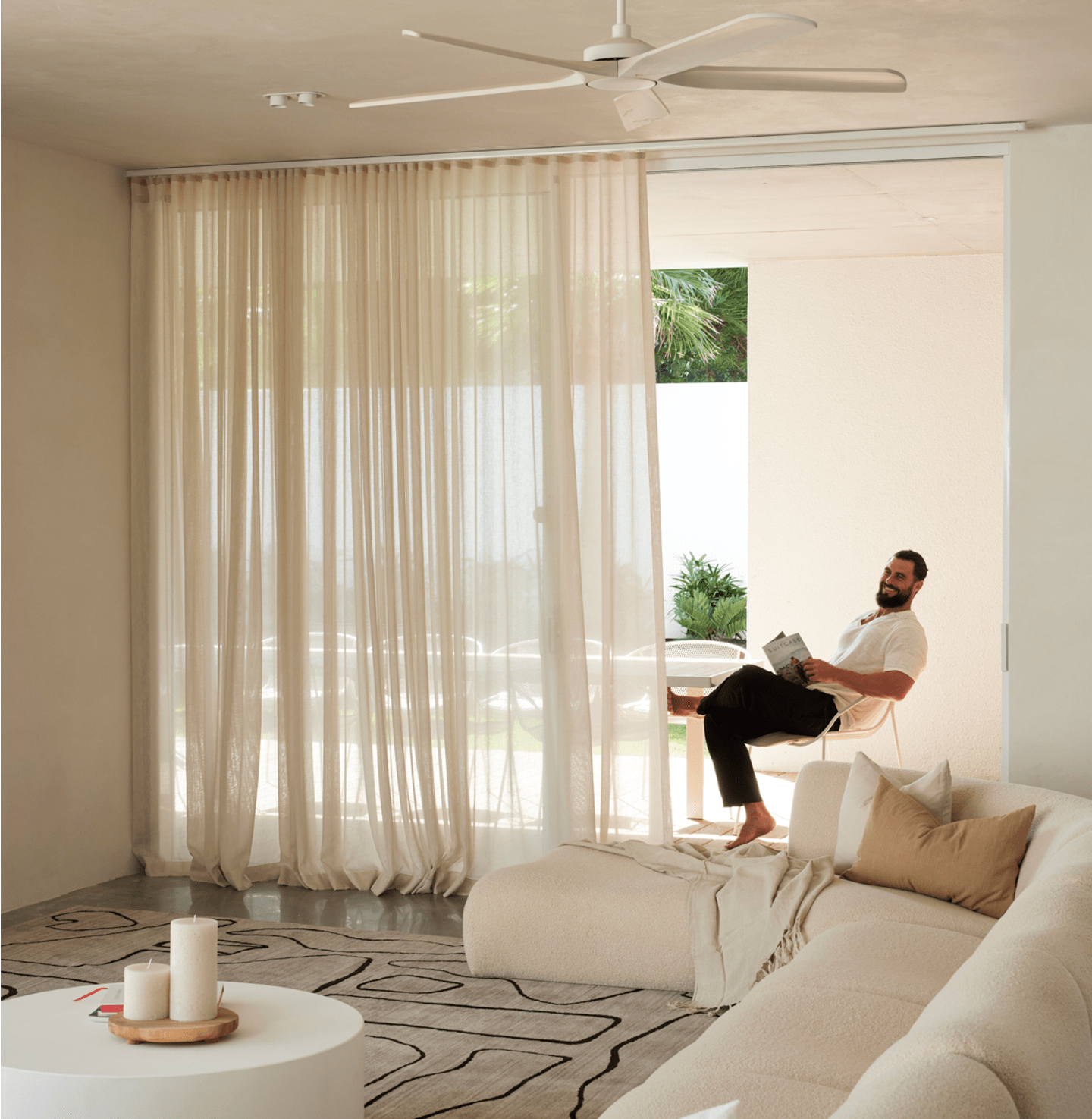
For a coastal living room, sheers are the easiest way to create an effortless, breezy vibe without overthinking it. Lightweight, light-filtering, and relaxed in the way they hang, they're the natural fit for homes near the water, or anywhere that's going for that feel. The practical side matters too. A polyester or polyester-blend sheer holds its shape, handles humidity and salt air better than natural fibres, and is much easier to clean.
Our exclusive Burleigh Sheers are designed exactly for this. Designed for the Aussie lifestyle, Burleigh is like SPF for your home, protecting your furniture, curtains, art, and flooring from harmful UV rays. Soft, elegant, and built to last, they bring that timeless coastal quality without ever looking overdone. Pair them with a ceiling-mounted S-fold track and a just-off-the-floor finish- so they don't get caught up in dust, pet hair, or foot traffic, and won't need as much maintenance in a high-traffic space - for an effortless designer look.
6. Motorised Curtains: The Upgrade Your Living Room Deserves
Motorised curtains used to feel like a luxury reserved for high-end builds. Not anymore. They're now one of the most practical upgrades you can make to a living room, and the price point has come a long way.
The idea is simple: your curtains open and close at the touch of a button, via an app, or on a schedule. Morning light at 7 am, privacy mode at sunset, all without getting off the couch. For wide windows, sliding doors, or ceiling-mounted wall-to-wall tracks, motorised is genuinely the easier option; manually drawing metres of fabric every day gets old fast.
From a design perspective, motorised curtains also look cleaner. No cords, no rods to reach for, no bunching from being pulled unevenly. The fabric moves in one smooth, even sweep every time, which is especially satisfying with an S-fold. If you're already investing in quality, made-to-measure curtains, motorising them is the natural next step.

7. Curtains Made for Your Windows: Bay, Box and Curved Spaces
Not every living room has a standard flat wall and a rectangular window, and off-the-shelf curtains show that immediately. Bay windows, box windows, and curved or angled walls all need a curtain solution that's designed for the space rather than forced into it.
Bay windows are one of the most common challenges in Australian homes. The mistake most people make is running one curtain rod straight across the front, which closes off the bay entirely and loses the architectural feature. The better approach is to follow the angle of the bay with a flexible or angled track, so the curtains sit close to the glass and the full depth of the bay becomes part of the room.
Box windows work similarly. A track that wraps the recess keeps things neat and intentional rather than awkward. For curved or arched windows, a bendable track system can follow the line of the frame exactly, which looks far more considered than hanging a straight rod in front of a curved window and hoping for the best.
Made-to-measure curtains are especially important here. A custom width and drop means the fabric sits exactly where it should: no bunching, no gaps, no curtains that are almost right.
8. Layered Curtains and Blinds for Maximum Light Control
If you want serious light control (which, honestly, most Australian living rooms should), layering your window treatments is the way to go. The idea is simple: different layers handle different jobs. Sheers filter morning light softly. Blockout blinds knock out afternoon glare. Curtains drawn at night add warmth, privacy, and insulation all at once.
The trick is to start with one focal point. Pick either the curtain or the blind as the design hero, then build around it with complementary tones and textures. In a room with timber floors and warm neutrals, a natural linen S-fold curtain as the backdrop layered with a blockout blind in a neutral textured fabric is a classic combination that just works
9. Lined Curtains for Australian Homes
For living rooms that face the street, a neighbour's fence, or a footpath (so, a lot of Australian homes), a lined curtain is the perfect way to balance privacy and style. Lining works by adding a second layer of fabric behind your sheer curtain panel, which blocks light and view while maintaining the colour and style of your hero fabric on the room-facing side.
Fully lined or blockout curtains are ideal for afternoon sun or anyone who needs the room dark during the day; it also helps you save on your energy bills, creating a thermal layer between the room. and the window. Most people don't realise lining doesn't change how your curtains look from inside the room at all: it's a purely functional upgrade that makes a big practical difference.
In smaller or cosier living spaces, pinch pleat curtains in a warm neutral that's a few shades deeper than your walls is a lovely combination: soft tonal contrast that adds depth and warmth without making the room feel smaller. Make it a lined curtain, and you've got a window furnishing that looks great and works hard.
10. Mix Curtains and Blinds Across a Room
Not every window in a living room needs the same treatment, and in fact, mixing curtains and blinds across a room is often what makes a space feel designed rather than just furnished.
The most common combination in an Australian living room is curtains on the main window or sliding door, and a roman blind or roller on a secondary window, like a side window or highlight window. The curtains do the heavy lifting visually; they add height, softness, and presence. The blind keeps the secondary window clean and functional without competing for attention.
The key to making it feel intentional rather than mismatched is staying in the same tonal family across both. If your curtains are a warm ivory linen, your blind should sit in a similar warm neutral, not identical, but clearly related. The difference in product type creates visual variety; the shared palette holds it together. With customised DIY blinds and curtains, you can find a perfect match across ranges. If you are worried about combining products, a free design session with an expert can help you choose.
It's also worth thinking about the room as a whole. A room with curtains on every window can start to feel heavy or closed in. A room with only blinds can feel bare. The mix gives you the best of both: softness and structure, warmth and practicality, without one treatment dominating the whole space.
Which Curtain Is Right for Your Room?
What you need | Where to start |
Large windows or high ceilings | Floor-to-ceiling curtains, hung as high as possible |
Smaller or cosier spaces | Lighter fabrics or sheers to keep it open and bright |
Privacy from the street | Lined or blockout curtains, or combine with a blind |
Total light control | Layer curtains with blockout blinds |
Modern, minimal look | S-Fold curtains on a track system |
Warmth and insulation | Lined or blockout curtains, wall-to-wall |
Wide windows or sliding doors | Wall-to-wall track, motorised if possible |
Frequently Asked Questions
How high should you hang curtains in a living room? As high as possible, ideally within a few centimetres of the ceiling, or mounted directly to the ceiling on a track. This makes the ceiling feel taller and the window feel larger than it actually is. Even in a room with standard ceiling height, hanging curtains high makes a noticeable difference.
What curtains make a living room look bigger? Floor-to-ceiling curtains in a colour close to your wall tone are the most effective way to make a living room feel larger. The eye reads the wall and curtains as one continuous surface, which creates a sense of width and height. Avoid curtains that stop at the window frame: they make windows look smaller, and rooms feel more cluttered.
What's the difference between a blockout curtain and a lined curtain? Blockout curtains are a single fabric with a thermal backing bonded directly to it, so the blocking is built into the fabric itself. Lined curtains combine a hero fabric (often a sheer or decorative fabric) with a separate lining layer, with a small gap between the two. This means you get to enjoy the look and texture of the front fabric while still getting the privacy and thermal benefits of the lining. It's a great option when you want the light-filtering quality of a sheer without sacrificing function.
What are S-fold curtains? S-fold curtains have a continuous wave-like fold from top to bottom, created by evenly spaced carriers on a track system. Unlike pinch pleat curtains, which have defined gathered pleats at the header, S-fold gives a soft, modern look with clean vertical lines. They're one of the most popular styles for contemporary Australian homes because they look effortless and are very easy to open and close. What fabric is best for living room curtains in Australia? Linen-blend fabrics are a standout choice for Australian conditions: they're breathable, handle heat well, and have a relaxed texture that suits everything from coastal to contemporary interiors. For rooms that need serious light control, a blockout lining is worth considering. Sheer fabrics work beautifully in rooms that get good natural light and don't need full privacy. For coastal or high-traffic spaces, a polyester blend is worth considering for its durability and easy care.